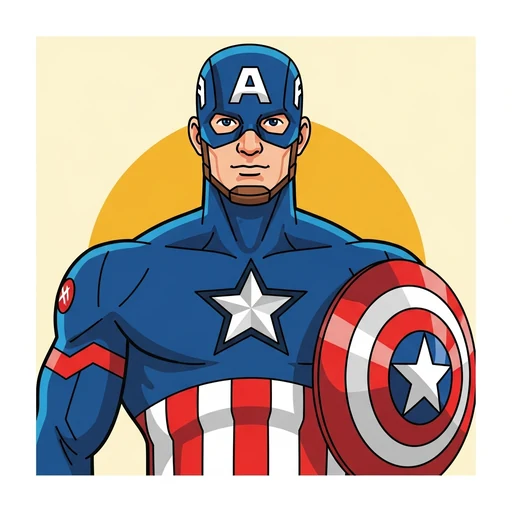
Frozen In Time
At the very end of the Second World War, in the icy skies high above the North Atlantic, Captain America climbed into the cockpit of a falling enemy plane.
The plane was huge. It carried terrible weapons aimed at America's cities. There was no time to land it. There was no time to disarm it. There was only one thing Steve could do.
He crashed it into the sea. On purpose. To save the cities.
He had time, before he pointed the plane down, to speak to Peggy Carter on the radio. He told her about the date he was going to miss. He told her where to find a good place to dance. He told her, even though his voice was steady, that he was scared.
Then the radio went silent. The plane hit the freezing ocean. The cold dark water closed over Steve Rogers, and that was supposed to be the end.
It was not.
Steve did not die. The super-soldier serum that ran through his veins, combined with the impossible cold of the Arctic ice, did something no scientist could have predicted. Steve was preserved. His heart slowed almost to nothing. His body did not age. He drifted, frozen, in a tomb of ice for nearly seventy years.
Seventy. Years.
Generations were born and grew old. Wars began and ended. Music changed. Cars changed. People walked on the moon. Computers fit inside telephones, and then telephones fit inside pockets, and then everybody had one in their hand all the time. The whole world moved on.
And Steve slept.
In the year that mattered, a research team finally found the wreck of the old plane buried in the ice. They were astonished to discover, inside, a man — a real, whole, breathing man — frozen so peacefully that he looked as if he had only just lain down to rest.
They thawed him carefully. They monitored his pulse. They held their breath.
He opened his eyes.
And the first thing Steve Rogers said, in a hospital room that was meant to look like the year 1945 but was just a little bit wrong, was the truth that he could feel in every bone.
"This isn't right. Where am I?"
He was, you might say, a man out of time.
The first weeks were the hardest. Steve walked out into modern New York City and almost could not bear it. The buildings were too tall. The lights were too bright. There were signs everywhere with strange logos. Cars whispered down the streets, then BLARED their horns. People stared down at little glowing rectangles in their hands instead of at each other.
The Brooklyn he had known was almost completely gone. The bakery where his mother had bought rolls — gone. The corner where Bucky used to wait for him after school — gone. The buildings he had grown up in — torn down, replaced with sleek glass towers. He walked his old streets and recognized almost nothing.
Everyone he had loved was gone too. Most of his friends had died of old age while he slept. His mother. His old neighbors. The little girls he used to walk home from school. Even Bucky — at the time — was believed to be gone forever.
Steve sat alone, sometimes, in his small modern apartment. He would put a record on an old phonograph he had asked S.H.I.E.L.D. to find him. He would listen to a song from 1941. And he would feel, somewhere under his ribs, an ache so big it was almost a sea.
Can you imagine what that must have been like? To go to sleep in one world and wake up in another? To be the last leaf still hanging from a tree in winter?
But Steve Rogers had not become Captain America by giving up.
Slowly, he learned.
He learned how to use a smartphone. He learned how to ride the new subway. He learned about the internet, which seemed equal parts wonderful and terrifying. He kept a little notebook in his pocket where he wrote down every reference he did not understand, so he could look them up later. The list grew long. He added to it every day. He still adds to it.
He learned, also, that the world had CHANGED for the better in some important ways. He saw progress in civil rights, in technology, in medicine. He saw people from all over the world able to talk to each other in real time. He saw children in schools learning things he had never imagined.
He realized, slowly, that the war he had fought had not been for nothing. The sacrifices of his generation had helped lay the foundation for the world he was now walking around in. It was not a perfect world. But it was a better one in many ways than the one he had left.
He made new friends. Tony Stark, brash and brilliant, the son of Steve's old friend Howard. Natasha Romanoff, sharp and watchful and surprisingly funny once you got to know her. Sam Wilson, the Falcon, who became one of the closest friends Steve had ever had. Thor, an actual thunder god, who liked Pop-Tarts. Bruce Banner, gentle and brilliant and sometimes very, very green.
They were nothing like the Howling Commandos. They were exactly like the Howling Commandos.
Steve learned, eventually, that being out of time did not mean being WITHOUT a place. The very thing that made him different — his old-fashioned values, his quiet straightforwardness, his willingness to do the right thing without overthinking it — was the very thing the modern world needed most.
He became a bridge. Between generations. Between past and future. A living reminder that some things never go out of style — honor, loyalty, kindness, courage.
These days, you can still sometimes find Steve sitting alone in a quiet park early in the morning. He will be drinking a coffee. He will be watching the city wake up. He will be thinking about Peggy, about Bucky, about all the people he loved who are gone now.
But then a small thing will happen. A jogger will smile at him. A kid on a bike will wave. A bird will sing.
And Steve will smile back, fold his newspaper, pick up his shield, and walk on.
The man out of time has found his place.
It was, all along, exactly where he was needed most.