Legacy Of Patriotism
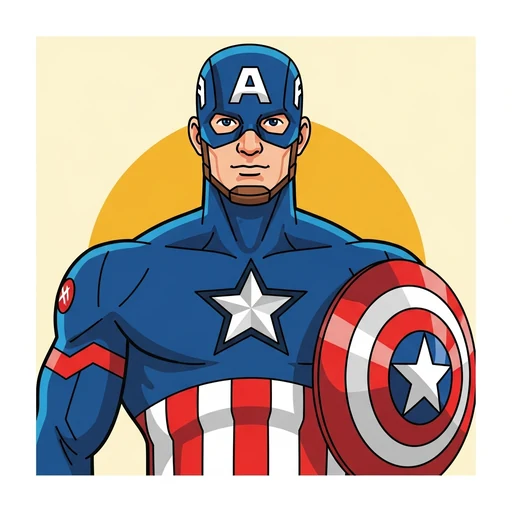
When people hear the name Captain America, many of them think first of the costume. The red, white, and blue. The big white star on his chest. The shield that bounces off walls and returns to his hand. The flag colors that have made him one of the most recognizable heroes on Earth.
But Steve Rogers will tell you that those are not what Captain America really means.
His shield is heavy, but it is only metal. His suit is bright, but it is only fabric. The real legacy of Captain America, he will tell you in his quiet steady voice, is an idea. A simple one. The idea that you have to stand up for what is right, even when it is hard. Especially when it is hard.
Steve has never believed that patriotism means blind loyalty. He does not think a person should follow a government just because it is their government. He does not think a person should obey a leader just because the leader has power. To Steve, true patriotism means loving the PRINCIPLES the country stands for — freedom, justice, equality, dignity — and being willing to stand up to anyone who tries to betray those principles. Even your own side. Even people in uniforms. Even people you used to trust.
This has, over the years, made Captain America an uncomfortable hero for some people in power.
There have been times when Steve has had to disagree, publicly, with the very institutions he was supposed to represent. There have been times when Cap has refused orders he believed were wrong. There have been times when he has even gone underground, abandoning the star-spangled name for a while, calling himself "Nomad" or "the Captain" — anything but Captain America — when he felt the country had wandered too far from its own values.
Each time, he made his way back. Each time, he picked up the shield again. Because the shield, you see, was never about flags. It was about PROTECTION. It was about standing between bullies and the people they wanted to hurt. That was the same thing Steve had been doing in Brooklyn alleys when he was a skinny kid getting punched for his trouble. The serum had made him bigger. The mission had not changed.
This way of being a hero has made Captain America a symbol that travels far beyond his country.
In faraway places, in cities Steve has never visited, people sometimes paint his shield on walls when they want to say, "We are not afraid." Children in countries he has never been to play with toy versions of his shield. Activists invoke his name when they speak out against tyranny. People all over the world look at Captain America and see, not a symbol of one nation, but a symbol of refusal — refusal to bow to cruelty, refusal to look away, refusal to give up.
That is the secret of his legacy. It belongs to everyone now.
It also belongs especially to the heroes Steve has mentored.
Sam Wilson, the Falcon — brave and kind, with great metal wings — learned from Steve that being a leader is about LISTENING more than commanding. When Steve eventually passed the shield to Sam to carry forward as the next Captain America, he did so because Sam had the same quiet, principled heart Steve himself had been trying to live by all those years.
The Avengers learned from Cap that power without character is dangerous. Tony Stark, who often disagreed with Steve, also often quoted him. Wanda Maximoff, who had every reason to be bitter, instead chose the harder road of doing good because Cap had shown her it was possible. Even Thor — a literal thunder god — sometimes paused to ask Steve's advice before making a big decision, because Cap's clarity cut through fog the way no thunderbolt could.
His mentorship has rippled outward. The next generation of heroes, the young ones who grew up hearing stories of him, will carry pieces of his way of being forward into a future Steve will never see. And that, more than any medal, is what Steve thinks of as success.
The artifacts of his legend are important too, of course. The shield is still iconic. The old footage of him jumping out of planes is still shown in classrooms. There are museums with his uniform on display. Kids still dress up as him every October.
But the deepest legacy of Captain America is something you cannot put in a glass case.
It is the feeling a frightened person has when a kind stranger steps in to help.
It is the courage a young person finds when they stand up to a bully on a playground.
It is the quiet moment when a worker speaks the truth at a meeting, even though it might cost them.
It is the choice — made over and over again, by millions of ordinary people in millions of ordinary moments — to do the right thing.
That choice is Captain America's legacy. It belongs to all of us.
These days, Steve Rogers is older. His shoulders are not quite as broad as they used to be. His face has lines now. He has lived more lives than most. But he still stands up when injustice walks into a room. He still raises his shield when someone needs protecting. He still finds, deep inside him, the small skinny boy from Brooklyn who could not stay down.
"I can do this all day," he used to say to bullies in alleys.
He still can.
As long as there are people in this world who believe in a better tomorrow, who refuse to be cruel, who choose courage over fear and kindness over cruelty, the legacy of Captain America will never fade.
The shield is heavy.
But the idea behind it is wonderfully, beautifully light.
And it belongs to you, too.