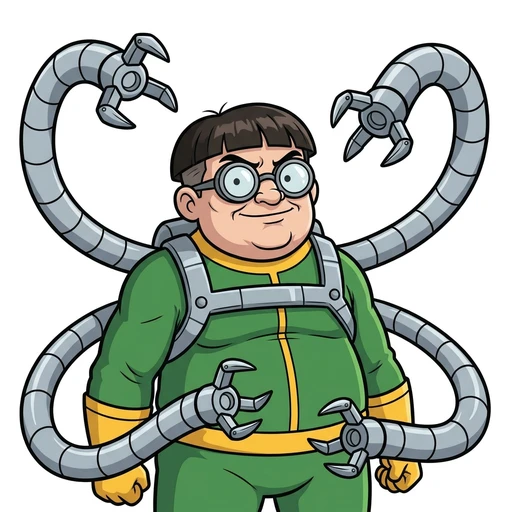
Four Mechanical Arms
Once upon a time, if you wanted to truly understand Doctor Octopus, there was only one place to start: his four remarkable arms, the ones he still, even now, gently calls his assistants.
Let me tell you about them, one detail at a time, the way Otto himself might explain it if you asked nicely.
Each arm is forged from a titanium alloy, a metal stronger than most of the steel beams holding up the tallest buildings in New York City. Each one can stretch out a full twelve feet when fully extended — taller than the ceiling of almost any room you have ever stood in. And each arm ends in a careful three-fingered claw, precise enough to pick up a single teacup without cracking it, and strong enough, if Otto wished it, to punch straight through a bank vault door.
Now here is the truly remarkable part, the part that made Otto Octavius famous among scientists long before he ever became famous among villains.
The four arms are wired directly into Otto's own nervous system, running straight through the harness that fused to his spine on that terrible day at the Atomic Research Center. This means Otto never needs a lever, never needs a button, never needs to steer his arms the careful way a person steers a car. He simply thinks — a small flicker of intention, barely a thought at all — and his assistants obey, instantly, perfectly. A girder begins to fall from a construction site, and a claw catches it before Otto has even fully registered that there was danger to begin with. Otto has often said, with a certain quiet pride, that it is the closest thing to a sixth sense any human being has ever built for himself.
Because of his four arms, Otto can do things that seem almost impossible. He can plant all four of them firmly against the ground and vault himself forward, arm over arm, reaching speeds close to forty miles an hour across rooftops and city streets — faster, believe it or not, than most cars manage in heavy Manhattan traffic. He can lift objects far too heavy for ordinary human arms to budge. He can pry open doors built to withstand explosions. He can balance, perfectly still, on a narrow ledge eight stories above a busy sidewalk, without a single wasted motion or a single wobble.
For a long while, walking through the city with his four arms curling gracefully behind him, Otto Octavius felt like the most powerful man in all of New York.
But here is something important that every good story about clever inventions eventually has to admit: every remarkable design, no matter how brilliant, has one single place where it can fail. And Otto's four arms, for all their titanium strength and their twelve-foot reach and their thought-controlled precision, are no exception.
All of that incredible power routes back through one small coupling, hidden at the base of Otto's spine, exactly where the harness first fused to his nervous system on that fateful day. Jam that one small coupling — with a burst of web fluid, or a well-placed jolt, or the right kind of clever interference — and all four arms freeze at once, no matter how strong or fast or unstoppable they seemed only a moment before.
Otto knows this weakness better than anyone alive, better even than Spider-Man, who discovered it and used it against him more than once. And that is because Otto himself is the one who built that weakness into his own design, all those years ago, back when he was simply a brilliant, hopeful scientist trying to solve a difficult problem.
It haunts him, sometimes, more than he would ever admit out loud to anyone — not even to Rosie, if she asked. The smartest man in Schenectady, holder of two doctorates, inventor of arms that could out-lift a crane and out-run a taxicab, brought down again and again by one small, overlooked coupling, no bigger than a clenched fist, hidden quietly at the base of his own back.
Perhaps, in the end, that is simply the way it goes for even the cleverest inventions in the world. The bigger and more powerful something becomes, the more carefully it must guard its smallest, quietest secret.
And Doctor Octopus, brilliant as he was, never quite learned how to guard his.