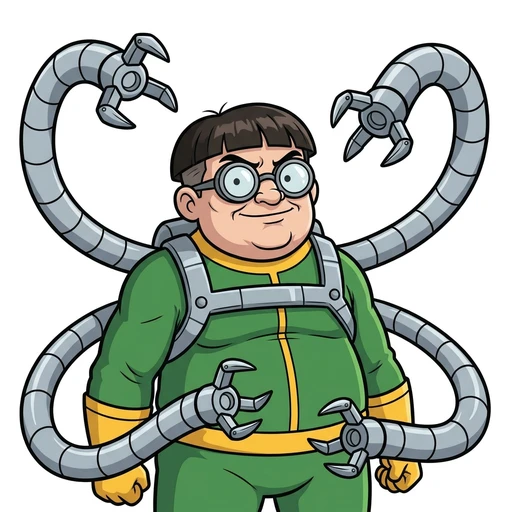
Blackout Plot
Once upon a time, Doctor Octopus decided to try something new — a plan so big that, this time, he wanted no teammates at all. Just himself, his four arms, and one very ambitious idea.
Under the cover of a quiet night, he broke into the Hudson Nuclear Research Facility, far outside the city. His four mechanical arms made quick work of security doors that had never faced anything quite like them before, prying and pulling with a strength no ordinary thief could ever match. Deep inside the reactor room, Otto found what he was looking for: a single nuclear core, glowing faintly blue in the dark. He lifted it carefully with one of his claws and slipped away into the night.
By morning, the guards discovered nothing but an empty casing where the core should have been. To them, it looked like an ordinary theft, troubling but explainable. To Otto Octavius, it was only the very beginning of something much bigger.
He carried the glowing core across the river and into the heart of Manhattan, straight to Oscorp Tower, one of the tallest buildings in the entire city. There, he seized control of the tower's enormous broadcasting antenna, climbing higher and higher until the streets below looked like tiny ribbons of light. From that great height, he made his announcement to the whole city, his voice carried out over every radio and television screen in New York.
Wire this stolen core into the right device, he said calmly, and he could cut electricity to all five boroughs of New York City at once — Manhattan, Brooklyn, Queens, the Bronx, and Staten Island — plunging ten million people into total darkness with nothing more than the flip of a single switch.
And then came his demands, which were, in a very particular Otto Octavius way, precise and proud rather than greedy. He wanted the city to officially declare him the greatest scientific mind alive. He wanted the Daily Bugle, the newspaper that had printed so many unkind things about him, to publish a full and public retraction. And he wanted every criminal charge ever filed against him dropped, completely and immediately.
Notice something important here, listener. He did not ask for money. Not one single dollar. He asked for respect — the very thing he had believed, ever since he was a lonely, brilliant boy back in Schenectady, that the world owed him and had never quite given him.
High above the city, Spider-Man swung toward the antenna platform just as Otto's device began to hum, sparks crawling across its metal surface like tiny blue snakes. Doctor Octopus fought back fiercely the moment he arrived, all four of his powerful arms swinging at once across the narrow platform, high above the glittering lights of the whole sleeping city below.
It was a dangerous, dazzling fight, high in the wind and the dark. But wiring a device complicated enough to threaten five entire boroughs takes precision. And precision, as every good scientist knows, takes time.
Time that Otto Octavius did not have.
Spider-Man ducked beneath a swinging arm, dodged another, and in one swift motion, tore the glowing core free from its half-finished wiring. It clattered harmlessly across the rooftop, rolling to a stop far from Otto's reach, its dangerous work undone before it had ever truly begun.
The lights of New York City stayed on that night. Every window in every borough kept its warm, steady glow, and down below, ten million people went about their evenings never knowing quite how close the darkness had come.
Doctor Octopus stood alone on that antenna platform, defeated once more, staring out at the very city he had wanted so badly to impress. Police officers climbed the long stairs and led him quietly away before midnight, his four arms hanging limp and still at his sides for once, the empty core left behind for engineers to safely collect at dawn.
But high above Manhattan, in that last quiet moment before the officers arrived, Otto Octavius looked out at ten million twinkling lights and felt something he did not expect to feel. Not triumph. Not even anger.
Just one small, uncomfortable thought, one he could not quite shake loose: he had never once stopped to ask whether the city actually wanted his greatness. He had only ever asked whether it would kneel to it.
It was a question Otto Octavius was not yet ready to answer honestly.
Not even to himself.
And so, dear listener, he was led away into the night, the city's lights glowing safely on behind him, and somewhere deep inside, a small, quiet part of Otto Octavius wondered, just for a moment, if there might have been a kinder way to be seen.