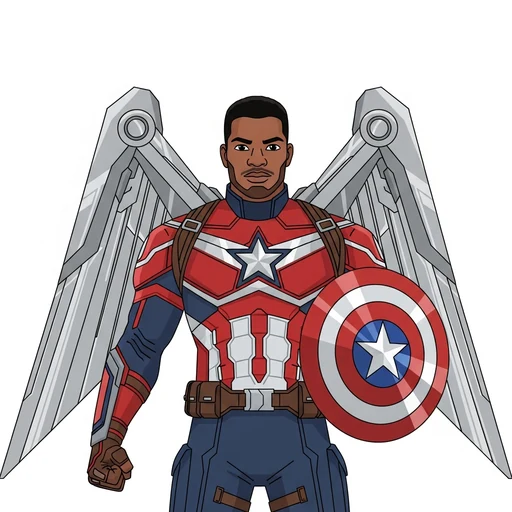
Becoming Captain America
For a long time, Sam Wilson did not want the shield.
This is the part of the story people forget. They remember the moment he flew out of the sky over New York in red, white, and blue. They remember the first time someone called him Captain America without quotation marks around it. But they forget how hard he tried, for almost a year, to give the shield away. And to understand the man, you have to understand the year.
Steve Rogers had walked across a quiet lake at the end of a very long life and handed Sam the shield with both hands. "Try it on," Steve had said. Sam tried it on. It was lighter than he expected, and somehow heavier at the same time. He carried it home to Washington, D.C., looked at it on his coffee table for a few weeks, and then did something almost no one expected.
He drove it to the Smithsonian Institution. He gave it to the museum.
He didn't make a speech. He didn't post anything. He just walked in, handed the shield to a curator, signed a piece of paper, and walked out. He told himself, very firmly, that the shield belonged to Steve and a different kind of man and a different kind of time. He was a pararescue from Harlem. He was a counselor at the VA. He was a son and a brother. He was not a symbol. He did not want to be one.
He drove south. He went to Delacroix, Louisiana, where his sister Sarah Wilson was trying to keep the family fishing boat from sinking under the weight of repairs no one had time for. He spent a long, sweaty summer scraping barnacles off the hull. He patched fiberglass. He repainted the bow. He played with his two nephews and ate gumbo at his sister's table and tried, very hard, to believe that the story was finished.
The world disagreed.
After Sam gave the shield to the museum, the government picked it up again. They handed it to a man named John Walker — clean-cut, Army-decorated, photogenic, and quietly broken in places he had not yet looked at. Walker took a vial of Super Soldier Serum from a shadowy figure. And one terrible day, in a public square in Latvia, in front of dozens of cellphone cameras, John Walker used the shield in a way no Captain America had ever used it. The vibranium came back red.
Sam saw it on the news. He stood in Sarah's kitchen with a dishrag in his hand and watched the footage and did not say a word for a very long time. Then he set the dishrag down and went out to the porch and looked at the sky.
He had made a mistake. He understood that now. The shield was not a museum piece. The shield was a symbol. And symbols cannot be handed to people who do not understand what they mean.
That was when Bucky Barnes showed up.
Bucky drove his motorcycle all the way to Louisiana — VROOOOM — and parked it on the dirt road in front of the Wilson house. He climbed off, walked up the porch in his heavy boots, and set a long flat case down at Sam's feet without a single word. He nodded once and went to sit on the porch swing.
Sam opened the case that night, alone, by lamplight. Inside was the shield. Bucky had spent hours cleaning it. Every trace of red had been polished away. The vibranium gleamed again, the way it had on the day Howard Stark first cast it in his Brooklyn lab.
Tucked beside the shield was a small folded note. It was from the King of Wakanda. The note promised a gift was coming. A few days later, a wooden crate arrived from across the world, and inside was a brand new suit. Vibranium wings, sharper and lighter than anything the Air Force had ever flown. A chest plate in red and white and blue. A white star in the center. The whole thing had been forged from a single sketch — drawn by hand by Princess Shuri herself.
Sam tried the suit on in his sister's bathroom. He looked at himself for a long time in the mirror.
Sarah Wilson appeared in the doorway with one hand over her mouth and the other on her hip. She studied him. She studied the suit. Then she said the most Sarah thing she could possibly have said.
"You better not get that dirty."
Sam laughed — really laughed, the first real laugh he'd had in months. The kind of laugh that loosens something tight in your chest.
He flew to New York that same week. The Flag Smashers were already moving. Karli Morgenthau was climbing toward the rooftops of Manhattan with a plan that was about to hurt a lot of innocent people. And when Sam Wilson burst through the skyline in red, white, and blue, with vibranium wings catching the sun and a polished shield on his arm — the city looked up.
The cameras followed. The news stations froze. And a single name passed across every screen in America at the same moment.
Captain America.
Not Steve. Not John Walker. Sam Wilson. From Harlem. From the 58th Pararescue Squadron. From Delacroix, Louisiana, where the family boat was finally seaworthy and his nephews were already telling everyone at school that their uncle was Captain America now.
Here is the thing about Sam that mattered most. He did not try to be Steve. He didn't try to talk like Steve, or fight like Steve, or stand like Steve. He stood like Sam. He fought like Sam. He spoke like Sam — quietly, with patience, in the voice of a man who had spent ten years sitting across from grieving veterans in a small VA office and listening to them, really listening, until they could find their own words again.
The shield felt different on his arm than it had felt on Steve's. That was the whole point.
Sam Wilson did not inherit being Captain America. He earned it. The long way. By giving the shield away first. By being honest about why. By learning, in his own time, that the world needed someone willing to carry it not because they were the strongest, but because they were the most patient.
And when the day came — when the wings opened, when the shield caught the light, when the city finally looked up — Sam was ready.
He had been ready all along.