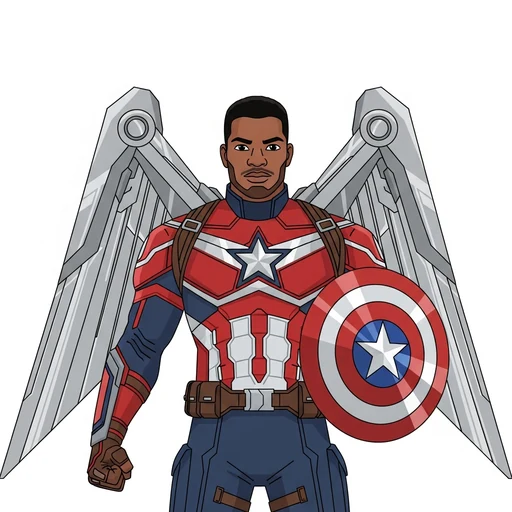
Sam And Bucky
After the Flag Smashers had been stopped, after the cameras had finally moved on, after every news channel in the world had said the name "Captain America" so many times that the word almost wore out, Sam Wilson and Bucky Barnes had a long ride ahead of them.
Fifteen hundred miles, give or take. From a rooftop in New York City all the way down to a fishing dock in Delacroix, Louisiana.
They borrowed a pickup truck from a friend of Sam's who knew not to ask questions. They loaded it down with tools — wrenches, drills, sanders, three different kinds of caulk, a coil of new rope, and a cooler full of sandwiches Sarah Wilson had insisted on packing. Sam took the first shift at the wheel. Bucky climbed into the passenger seat, rested his vibranium arm on the door, pulled a baseball cap low over his eyes, and looked out at the road.
They did not speak for the first three hundred miles.
This was new. The Sam and Bucky of a year earlier could not have shared a quinjet for ten minutes without arguing about whose turn it was to wash the dishes back at the safe house. But something had shifted between them during the long mission against the Flag Smashers. They had argued in a cargo plane and they had fought side by side in Latvia and they had walked into a Sokovian castle to ask Helmut Zemo for help. They had carried each other home from a final battle in New York with the shield passing back and forth between them like it had always known both their hands. And now, on this drive south, they were comfortable in the quiet for the first time. They didn't need words anymore. The quiet was the trust.
When they finally pulled into Delacroix in the late afternoon, the cypress trees were dripping moss over the bayou and the air smelled like salt and gasoline and someone's gumbo on a back porch.
Sarah Wilson was waiting on the porch of the Wilson family home with her two boys, Cass and AJ, on either side of her. She watched the rusty pickup roll up the dirt road. She watched her brother get out, dusty and tired. She watched the man with the metal arm get out behind him.
Sarah Wilson, in her own quiet way, was one of the bravest people Sam knew. She had raised two boys mostly alone. She had kept the family fishing business going through hurricanes and snap reversals and a hundred broken parts. She could read a man's face the way other people read a weather report, and what she saw in Bucky Barnes that afternoon was a person who needed somewhere safe to put down a very heavy bag.
She handed Bucky a glass of sweet tea. She pointed at the chore list on the fridge.
"There's a list," she said. "Start at the top."
Bucky walked into the kitchen. He read the list. The top item, written in Sarah's neat handwriting, was leaky bilge pump on the Paul and Darlene. The second item was broken winch. The third item was kitchen screen door — won't latch. Bucky nodded once, gravely, the way a soldier nods when he has just been given a meaningful mission. He set the glass of sweet tea on the counter. He picked up a wrench.
What happened next was, for Bucky Barnes, the closest thing to a vacation he had ever had.
For three weeks, he stayed.
He scraped barnacles off the hull of the Paul and Darlene — the family fishing boat that Sarah had been trying to restore for two years. Cass, who was nine, decided Bucky was the most interesting person who had ever visited the Wilson house and asked him approximately a thousand questions about the vibranium arm. Is it heavy? Can you feel it? Can you bend a pipe? Can you pick up a truck? Could you pick up two trucks? Bucky, who had not had a conversation with a nine-year-old in seventy years, answered every single question. Some of his answers made Cass laugh out loud. Some of them made Cass go quiet and think for a long time. Bucky did not mind either reaction.
He fixed the broken winch. He re-hung the kitchen screen door that had been hanging crooked since the spring. He learned, with Sarah's patient instruction, how to crack open a crab without losing any of the meat. He sat at the dinner table on a Wednesday night and ate gumbo and corn bread and laughed — really laughed — at one of AJ's jokes about a fisherman and a pelican.
He walked the bayou at sunset with Sam, more than once. They watched herons lift off the water and circle slowly against a pink sky. Bucky did not say much on those walks. Sam did not push him. They just walked, side by side, two men who had once not liked each other and now were close enough to share silence.
Here is the part that mattered the most.
For three weeks, Bucky Barnes did not check his phone. He did not pick up the notebook where he had been writing the names of the people the Winter Soldier had hurt. He did not have nightmares. He did not flinch when a door slammed. He slept through entire nights. He was simply present — in his body, in that family, in that town — in a way he had not been since he was a boy in Brooklyn, before the war, before HYDRA, before any of it.
It turned out that the bravest thing Bucky Barnes had ever done was let himself be ordinary for a little while.
On the last morning, Bucky carried his bag out to the porch. He shook Cass's hand like Cass was a grown man. He shook AJ's hand the same way. Then he turned to Sarah Wilson and he opened his mouth to thank her and the words just would not come. They were too big. There was no sentence in any language that could fit what he was trying to say.
Sarah, who had been a sister and a mother and a widow and a fisherwoman and now apparently a quiet healer of broken super-soldiers, simply hugged him.
"Come back whenever," she said softly. "There's always a list."
Bucky held on for a second longer than he meant to. Then he let go.
He climbed into the pickup. Sam slid in next to him. They waved out the window as Cass and AJ ran alongside the truck for half a block before falling behind, laughing. The Mississippi Delta slid past the windows — green and wide and shining.
After about an hour, Sam glanced over.
Bucky was asleep. Head against the door. Baseball cap over his eyes. The metal arm relaxed in his lap. Sound asleep, in the deep way a body sleeps when it has finally decided it is safe.
Sam Wilson did not wake him up. He turned the radio down low. He kept his eyes on the road. He smiled, just to himself, the small smile of a man who knew that healing doesn't come in big dramatic moments. It comes in pickup trucks. It comes in chore lists. It comes in three weeks of barnacle scraping and herons at sunset and a sister who tells you exactly what to do with your hands.
Sometimes the most heroic thing two partners can do for each other is just keep showing up. And sometimes the second most heroic thing is to let each other, finally, rest.