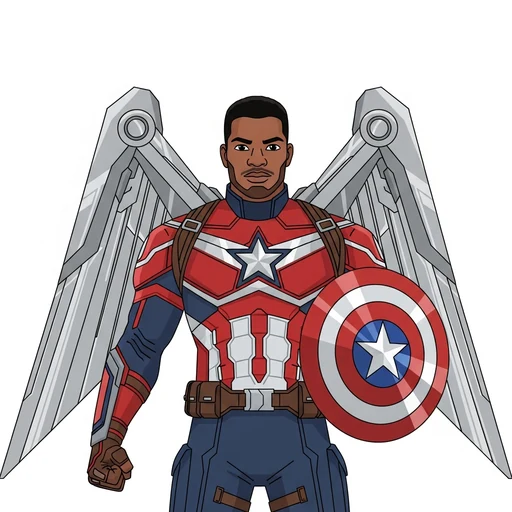
Isaiah Bradley
There is a story Sam Wilson did not learn until he was almost ready to put on the shield. It is one of the hardest stories in the whole Captain America history — and it is, in some ways, the most important one. It is the story of Isaiah Bradley.
To understand it, you have to know something. The Super Soldier Serum that made Steve Rogers strong — the formula that turned a small, frail soldier from Brooklyn into Captain America — was not used only once. After Steve disappeared into the ice in 1945, the United States government spent years trying to make more super soldiers. They tested versions of the formula on volunteers. Some of those volunteers got very sick. Some of them died. And a small group of Black soldiers, during the Korean War, were given the serum without being told what was being done to them.
Isaiah Bradley was one of those soldiers.
He survived. More than survived. The serum worked on Isaiah the way it had worked on Steve. He became as strong as Steve Rogers, as fast as Steve Rogers, and just as brave. The government sent him on secret missions that no history book ever published. He fought enemies the world was never told about. He saved lives no one ever counted. He even, in one quiet skirmish, came face to face with a young soldier called the Winter Soldier and managed to break the Winter Soldier's metal arm clean off. Bucky still remembered it.
And then, when Isaiah came home, instead of a medal, instead of a parade, instead of a quiet pension and a thank-you handshake, the United States government locked Isaiah Bradley in a cell. They told the world he was dead. They kept him there for thirty years and ran experiments on him — taking samples of his blood, watching how the serum changed inside his body, treating him like a thing instead of a man.
When he finally got out, decades later, the country had moved on without him. Isaiah went to live in a quiet brick house in a quiet neighborhood in Baltimore with his grandson Eli. He kept his head down. He did not give interviews. He did not write a book. He fixed the roof when it leaked. He cooked breakfast for Eli every morning. He carried, very privately, a lifetime of being unmade by his own country, and he did not want anyone to come knocking with a shield and a question.
But one day, Bucky Barnes did.
Bucky brought Sam with him. He did not warn Sam first. He drove Sam to Baltimore, parked outside Isaiah's house, and said simply, "There's someone you need to meet."
Isaiah opened the door. He was an older man now, his shoulders square, his eyes patient and tired in the way of someone who has been failed by every uniform in his life. He looked at Bucky. He looked at Sam. And then he stepped aside and let them come in.
He poured two cups of coffee. He sat across from them at his kitchen table. And he told Sam everything.
He told Sam about the serum. He told Sam about the missions. He told Sam about the cell. He told Sam about the doctors and the needles and the long, quiet decades of being held as a secret. He told Sam, plainly and without anger, that the country had broken its promise to him. He told Sam that he would never call himself Captain America. He told Sam that the world would never let a Black man wear that uniform without making him pay for it. He told Sam to leave the shield on the floor of a museum where it could not hurt anyone.
Sam listened. He did not interrupt. He did not try to argue. He drank his coffee and looked at the kitchen table and let Isaiah finish.
When Sam left, he carried Isaiah's story with him like a weight in his chest. Every fight he had with the Flag Smashers, every conversation with John Walker, every press conference he did not want to give — he thought about Isaiah Bradley sitting in that little kitchen in Baltimore. He thought about a man who had been a hero and a prisoner and then a ghost in his own country.
For a while, Sam wondered if Isaiah was right. Maybe the shield really should be left on a museum floor.
But then something shifted. Sam realized that walking away from the shield would not honor Isaiah. It would just leave the shield in someone else's hands — someone who did not know Isaiah's name and never would. Sam decided, slowly, that the way to honor Isaiah was not to disappear. The way to honor Isaiah was to be loud. To be patient. To use the shield exactly the way Isaiah had been promised it could be used, and never was.
So Sam Wilson became Captain America. He put on the red and white and blue. He flew through the Manhattan skyline. He stopped the Flag Smashers. He stood in front of the cameras and gave a careful, honest speech to a council of world leaders. He earned the shield, the long way.
And then he did one more thing.
After the dust had settled in New York, after the Flag Smashers were finished, after the cameras had finally moved on, Sam went to the Smithsonian Institution. He walked into the quiet front office. He sat down with the curators. He asked them to build something.
Months later, the Captain America exhibit had a new wing.
In the center of that wing was a tall glass case. Inside the case were three things: a uniform, a black-and-white photograph, and a name in clean white letters at eye level.
ISAIAH BRADLEY.
Sam drove up to Baltimore. He parked outside Isaiah's brick house. He knocked on the door. Isaiah opened it. So did Eli, peeking around his grandfather's arm. Sam asked them both, very politely, if they would come with him to Washington that afternoon. He told them he had something to show them.
The drive was quiet. Isaiah looked out the window the whole time, his hands folded in his lap, his face unreadable.
When they walked into the new exhibit, the Smithsonian was almost empty. A few kids on a school trip stood at the other end of the hall. A guard nodded at them and stepped back. Sam led Isaiah and Eli into the new wing.
Eli saw it first. He squeezed his grandfather's arm.
Isaiah Bradley looked up.
He saw the uniform. He saw the photograph — a young version of himself, in fatigues, smiling carefully in a way he had not smiled in sixty years. He saw the name.
ISAIAH BRADLEY.
He stood there for a long time. He did not move. He did not say anything. And then, very slowly, this man who had survived a war, survived a cell, survived thirty years of being unmade by his own country, this strongest man any of them had ever known — Isaiah Bradley began to cry.
Not loudly. Not dramatically. Just quietly, the way a person cries when they have been waiting their whole life for one small, decent thing.
Eli held his grandfather's arm. Sam stood a few steps back, hands folded in front of him, and let Isaiah have the moment.
Outside the Smithsonian, the city was cold and bright and going about its business. Inside the new wing, with the lights warm on the glass case and the white letters of his name finally on the wall, Isaiah Bradley was finally, finally being seen.
Sam could not undo what had been done. He knew that. No one ever could. But he could make sure that from this day forward, every child who walked into the Captain America exhibit at the Smithsonian Institution would see Isaiah Bradley's name first. Would read the story. Would know.
That is what Sam Wilson did with the shield. Not just fight battles. Not just save the city. But carry forward the names that had been hidden, and put them, gently and firmly, where the world could not look away.
That, more than anything else, was why he was Captain America.