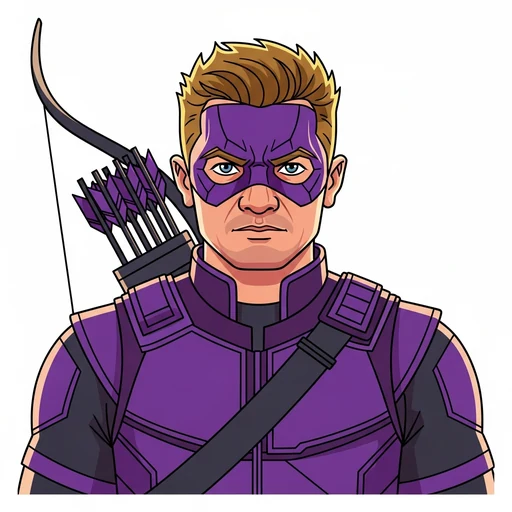
Trick Shot
The thing about teachers is that you carry them with you. Even when they're gone. Even when the relationship has ended in a way that is difficult to explain to other people. The lessons stay — in your hands, in your body's memory, in the automatic responses that surface in moments of pressure and prove that everything you practiced once is still there.
Clint Barton carries Trick Shot with him every time he raises his bow.
Trick Shot — real name Barney Slade, though he considered this information on a need-to-know basis — was not a gentle teacher. He was not a patient teacher in the way that patient is usually meant. He was relentless and demanding and had a way of setting up training challenges that made Clint wonder, in the moment, whether this was technically a kind of attack. Impossible angles. Moving targets. Wind that shifted mid-draw and had to be compensated for mid-flight. Targets positioned in places that required Clint to shoot from positions that no textbook on archery had ever seriously considered.
"Again," Trick Shot would say, when Clint missed. Not with disappointment — with the flat certainty of someone who knew the student would hit it if they kept going. "Again." And again. Until the arrow flew true.
There was something almost like love in this, even if neither of them would have used the word.
The training covered the fundamentals in a way that went deeper than fundamentals: how to read the wind not from a flag or a weather vane but from the way it touched the back of your hand; how to adjust for distance not through calculation but through a feel that lived in the muscle and the eye and the years of repetition; how to shoot from positions that compromised balance, compromised sightlines, compromised everything a clean shot was supposed to have. Because in a real situation, clean shots were a luxury you rarely got.
Clint became the best archer in the circus. Then the best archer Trick Shot had ever trained. Then, eventually, the best archer Trick Shot had ever seen.
This is where it got complicated.
Trick Shot's moral world had always been flexible in ways Clint had been too young to see clearly at first. Criminal connections, jobs on the side that didn't bear examination, the gradual revelation that the skills he had poured into making Clint extraordinary were deployed for purposes that Clint would have found intolerable if he'd understood them earlier.
When Clint found out — not all of it at once, but enough — he made the only choice that was consistent with who he was.
The confrontations came, over the years, like visits from a complicated past. Trick Shot resenting the student who had surpassed him, turned the training against its original purpose, and made it into something genuinely good. There was bitterness in those confrontations — the specific bitterness of someone who recognizes that their best work is being used against them, and that the student has become better than the teacher by choosing a better path.
Clint fought those confrontations the same way he fought everything: with the technique Trick Shot had built into his bones, redirected toward the opposite of what Trick Shot had intended.
Every arrow Hawkeye has ever fired carries Trick Shot's influence — the angle of the elbow, the feel of the draw, the instinctive wind-reading that happens before conscious thought gets involved. This is the legacy of teaching: it persists in the student even when the teacher is gone, even when the teacher's choices have made them the thing the student stands against.
What we are given doesn't have to be what we become.
Clint Barton took everything Trick Shot had given him — all of it, the discipline and the precision and the fearlessness in impossible conditions — and chose to use it differently.
The shadow you step out of can still be the thing that taught you to step.
He never forgot Trick Shot. He never stopped being grateful for the training and refusing the rest.
Both things, at once. That is how it sometimes is.