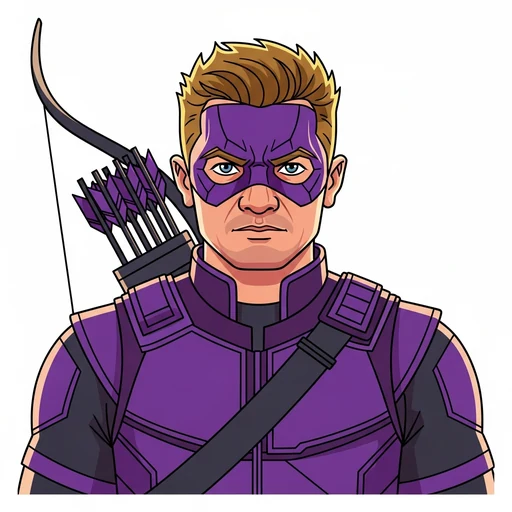
Swordsman
The Swordsman moved the way weather moves — big and inevitable, filling whatever space he occupied, leaving a different atmosphere behind him when he was gone. His name was Jacques Duquesne, and he was the kind of performer who made the audience forget to breathe. Every bladed weapon in his hands became an extension of himself: sabers, rapiers, knives, even the trick weapons built with concealed tricks — all of them operated with a fluid mastery that Clint Barton, watching from the edge of the ring at age eleven, found completely captivating.
He asked to learn. The Swordsman, who had an instinct for useful talent, said yes.
What followed was the second education of Clint Barton's circus years — and in some ways the broader one. Trick Shot had given him archery, the relationship between eye and hand and air and target. The Swordsman gave him everything else: footwork that could be adapted to any fight, timing as a concept (not just in weapons work but in the rhythm of any confrontation — when to press, when to wait, when the moment had arrived and you had to be already in motion or lose it), the performance instinct that made a fight something other than just collision.
The Swordsman called this showmanship. Clint came to understand it as battlefield awareness: knowing not just what was in front of you but what the fight looked like from every angle, what the audience — or the opponent — expected to see, and how to do the thing they didn't expect.
He was flamboyant. He was charismatic. He told stories at dinner with the exuberant confidence of someone who had decided a long time ago to be interesting. Clint admired him, the way young people admire the person who fills a room with ease and seems to have solved problems that feel impossible from the outside.
And then came the night in the back lot of the carnival.
Clint saw him. The theft was not subtle — not clever enough to be concealed from a boy who was already developing the observational habits that would make him extraordinary. The Swordsman was taking money that belonged to the carnival's management, with the practiced ease of someone doing something familiar.
Clint could have kept walking. He didn't.
The confrontation that followed was not between equals, in any physical sense. The Swordsman was an adult and a master of every fighting technique he had spent months teaching Clint. The result was exactly what you would expect. Clint survived. It cost him. It solidified something in him that might have been more gradual in an easier life: the understanding that talent without character is dangerous, that charisma is not the same as integrity, and that refusing to stay silent when you see something wrong is sometimes the most expensive choice you can make.
Years later — Clint already an Avenger, the Swordsman gone through his own complicated chapters — their paths crossed again. The Swordsman moved between villain and something more ambiguous, between the criminal world that had always welcomed his skills and a desire for something different that he struggled to fully choose. He and Clint fought. They talked. Neither outcome was entirely clean.
The encounters taught Clint something specific about forgiveness: that it doesn't require pretending the harm wasn't real, or that the person has fully changed. It requires choosing not to let the harm be the last word.
The Swordsman's influence remained in Clint's fighting in ways he couldn't always identify specifically — a fluidity in close-quarters situations that went beyond what archery training alone produced, a flair in his movements that was occasionally more theatrical than strictly necessary, an instinct for the moment that felt like pure timing.
Talent without character is dangerous. Clint had lived this lesson up close and had taken from it the opposite of what the Swordsman had modeled: a commitment to character that held its shape even when it was expensive to maintain.
The master's flair. The student's integrity.
Both of them, every day, in the way Hawkeye moved.