Doctor Octopus
Close your eyes for a moment and imagine the tallest building in Manhattan. Now imagine something huge climbing it — not a spider, not a crane, but four enormous metal arms, each one twenty-four feet long, each one moving like a serpent through the sky. Imagine the sound they make: CLANK. CLANK. CLANK.
That is Doctor Octopus.
But he was not always this way. Once, not so long ago, Doctor Otto Octavius was one of the smartest men in all of New York City. He wore round glasses and a rumpled lab coat, and he spent his days at a nuclear research laboratory, studying the tiniest particles of matter in the universe. He was quiet. He was careful. He was respected.
The problem was that Doctor Octavius worked with radioactive materials — dangerous stuff that could hurt you if you touched it. So he invented something wonderful: four long mechanical arms, attached to a harness around his chest, controlled entirely by his own thoughts. He could think left and the left arm reached left. He could think up and they all rose together like a strange metal flower blooming toward the ceiling.
Those arms could feel radiation the way your fingers feel heat. They could lift eight tons each. They could strike with the force of a jackhammer. And they moved — oh, how they moved — at ninety feet per second, quick as a whip crack.
For a while, everything was fine.
Then came the accident.
An explosion in the lab. A blinding flash of light. A wave of radiation that swept over Doctor Octavius and changed him, deep down in the parts of him that made him who he was. The arms fused to his spine. His brilliant mind bent and twisted like a piece of hot metal.
When Otto Octavius woke up, he was no longer the careful, quiet scientist.
He was Doctor Octopus. And Doctor Octopus was very, very angry.
He used his arms to steal. To scheme. To terrorize. He moved across the rooftops of Manhattan like a mechanical spider — CLANK, CLANK, CLANK — while the people below scattered and screamed.
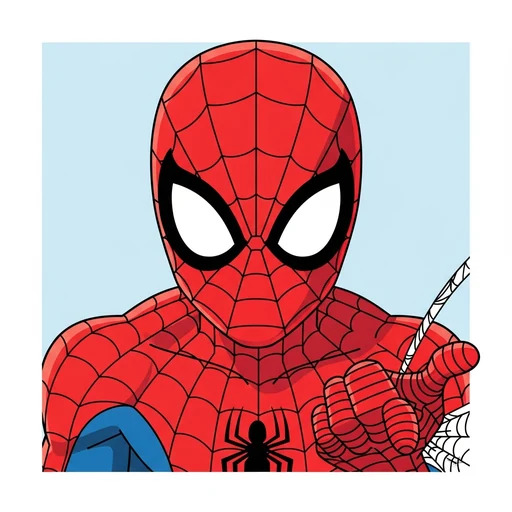
Peter Parker was eating his lunch — a peanut butter sandwich Aunt May had made — when his spider-sense began to tingle. That prickling at the back of his skull. That secret alarm. Something dangerous was close.
He found Doctor Octopus on top of a moving subway train, and the fight that followed was unlike anything Peter had ever experienced. BOOM — an arm smashed into a water tower. CLANK — another swept across the rooftop. Doctor Octopus fought from four directions at once, and Spider-Man had to roll and duck and leap and swing, trusting that little tingle in his skull to keep him one step ahead of the whirling metal limbs.
"You're just a child in a costume!" Doctor Octopus roared, and two of his arms crashed together above Peter's head like giant cymbals. CLANG!
But Peter had been watching. And Peter was very, very smart. He had noticed something: the harness that connected the arms to Doctor Octavius — the chest harness — that was the key. Not the arms. The harness.
THWIP! A web strand coated the control panel on the harness. THWIP! Another wrapped around the junction where the arms connected to their power source.
Then Peter reached out and pulled — hard.
There was a crackling sound, like a string of sparks popping. The arms went limp, twitching, then still. Doctor Octopus stumbled and fell, his magnificent terrible limbs silent and heavy around him.
Peter stood over the fallen villain and felt something unexpected: not triumph. Sadness.
Because he could see the man inside the monster. He could see Otto Octavius, the brilliant scientist who had once wanted to help the world. He could see what happens when a great mind turns away from kindness and toward cruelty.
He thought of Uncle Ben. He thought of responsibility.
"You were going to change the world," Peter said quietly.
Doctor Octopus said nothing. But his four mechanical arms — so clever, so powerful, so very wasted — lay still around him in the moonlight like four sleeping serpents.
Spider-Man shot a web to the nearest building and swung away, up into the Manhattan sky, past the glittering towers and the golden glow of a million apartment windows, back toward Queens, back toward Aunt May's house, back toward his peanut butter sandwich.
Some battles, he had learned, leave you with a full heart and a heavy one, both at the same time.
THWIP.