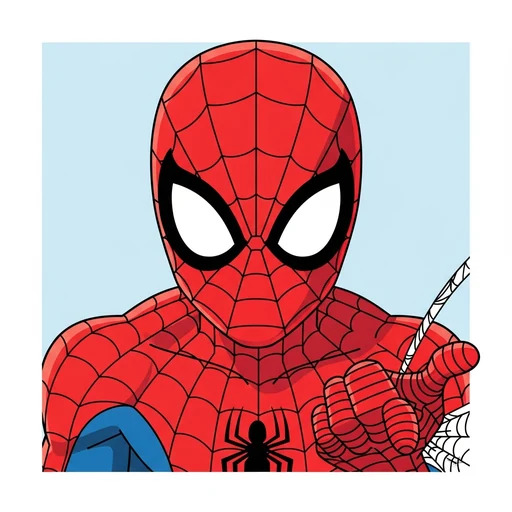
Mysterio Illusions
Have you ever looked in a mirror and seen something that wasn't quite real? Have you ever been absolutely certain you heard something — a bump, a whisper, a footstep — and then found… nothing there?
That is what Mysterio does. That is his whole game.
His real name was Quentin Beck, and before he became a villain, he worked in Hollywood making movies. He was a special-effects wizard — a man who could make you believe a spaceship was flying overhead, or a dragon was breathing fire, or a whole city was crumbling to the ground. He was brilliant at make-believe.
But nobody gave him credit for it. He was a stuntman, they said. He was just the effects guy, they said. And that made Quentin Beck very, very bitter.
So he decided: if no one would notice him doing good things, they would certainly notice him doing terrible ones.
He built himself a costume — a dark green suit and cape, with two enormous glass eyes on the shoulders, and — most wonderfully strange — a great round dome for a helmet, like a fishbowl placed over his head. Inside the dome, a fog machine puffed a swirling mist that turned his face into a ghostly shadow. You could not see his eyes. You could not see his expression. You saw only the mist, and it was deeply, deeply unsettling.
He called himself Mysterio.
He made his dome from one-way glass, so he could see perfectly out, but no one could see in. His costume sprayed gases — soft sleeping gases, gases that confused your thoughts, gases that made your eyes see things that were not there. His boots had springs in them. His cape sparked with electricity. And he carried holographic projectors that could paint whole monsters onto the walls of buildings, fill a room with phantom armies, or make the solid floor seem to fall away beneath your feet.
WHOOOOSH — a dragon appeared above Manhattan. BOOM — a chasm opened in the road. CRACK — lightning flashed from a clear blue sky.
None of it was real. All of it was Mysterio.
He framed Spider-Man for crimes he had never committed. He turned the newspapers against him. He made the whole city believe their hero was a menace. And then he lured Spider-Man — the real Spider-Man, Peter Parker, tired and confused and doubting himself — into an old abandoned theater on the edge of the city.
Inside, the floor rippled like water. The walls moved. Shadows reached out as though they had hands. Giant monsters rose from the darkness, roaring and snapping. Peter's spider-sense — his precious alarm, his best friend — was scrambled by tiny hidden drones buzzing around him, filling the air with interference.
For the first time, Peter Parker could not trust his own eyes.
He tumbled. He swung into walls he couldn't see coming. He fought shadows that dissolved the moment he touched them. He was completely and totally lost.
And then Peter Parker did something very brave.
He stopped.
He closed his eyes.
In the darkness behind his eyelids, with all the tricks and lights and roaring monsters shut out, he breathed. He listened. He felt.
His spider-sense was weak — but it was there. Just the faintest tingle, like a candle flame in a windstorm. He turned toward it. He moved slowly, trusting that quiet signal in his skull, ignoring everything his eyes were desperately trying to show him.
Step. Step. Step.
The monsters howled. The floor seemed to shake. A voice boomed from everywhere at once: "You can't win, Spider-Man! You don't even know what's real!"
Peter kept walking. Eyes closed. Following the tingle.
And then his fist connected with something solid.
Something human-sized.
Something that made a very satisfying CRACK.
Mysterio's great fishbowl helmet shattered. The mist poured out and dissolved in the theater air. The monsters vanished. The moving floor went still. The roaring stopped.
And there stood Quentin Beck, in his green costume, without his helmet — just a man. A lonely, clever, bitter man who had spent years making other people see things that weren't there.
Peter looked at him for a long moment.
"You could have made movies," Peter said. "Really great ones."
Quentin Beck had no answer for that.
Peter shot a web, called the police, and swung out through a shattered theater window into the real New York night — the actual stars overhead, the actual traffic below, the actual smell of the city rising up around him.
Real. Solid. True.
THWIP. THWIP. THWIP.
And as he swung home, Peter Parker understood something important: the most powerful thing a hero can do is trust what they feel, even when the world is doing its very best to make them believe something different.
Your instincts know the truth. Close your eyes, and you will always find your way.